Showing posts with label Saints. Show all posts

Thursday, January 30, 2014

For the Feast of St. Thomas Aquinas

(This really should have gone up a few days ago, but better late than never)


Vivat Christus Rex!

Thursday, November 14, 2013

Why Saints Are Like Pagan Deities

                A frequent objection by our Protestant friends about the Catholic practice of honoring the Saints is that it is overtly reminiscent of polytheism, with the various gods dedicated to different aspects of the world replaced by the various Patron Saints of the Catholic calendar.
                And, in this, they’re quite right. The Saints are indeed fairly closely akin to the gods of ancient Greece, Rome, and so on. Where Protestants are mistaken is in thinking that these gods were at all akin to God. It’s more a confusion of language than of concept really; we use the same word for the pagan deities as for the Blessed Trinity, when it'd be closer to the truth to use the same word to describe the pagan deities and the Blessed Saints and Angels.
                It’s easy for us to forget, because we’ve grown used to the idea of an eternal, omniscient, omnipotent God who transcends nature and time because He created both, that the pagan gods had none of these qualities. Zeus was the king of the gods and the ruler of the air, but he was not omnipotent (he had to fight a ten year war to earn his throne) and he did not create nature. Quite the reverse; Mother Earth is his grandmother and the Sky is his grandfather. Odin likewise was fairly far removed from the birth of creation, his grandfather having been licked out of the primeval ice by an ancient cow (it’s paganism; get used to it). He helped make the world out of the remains of the giant Ymir, but obviously there was some sort of ‘world’ going on with Ymir, the cow, and all that ice. Nor was he omniscient (he needed his two crows to bring him news).
                See, the pagan gods were more like stewards of creation, or at least, like ruling princes who schemed and inherited their way into dominion of a world that they were just as much a part of as humanity. The gods of Greece and Rome and Babylon were, in short, a part of nature, just like the sun or the stars (sometimes they were the sun and the stars). They had their own roles to fulfill, and as such wielded much greater power than human beings, but they were ‘creatures’ just as humans or animals were ‘creatures.’ They were not the Prime Movers, nor were they being itself. They, as much as humanity, answered to a higher authority than themselves.
                Now, as you can see, exalted creatures serving a higher authority and helping to order and steward creation is indeed a fairly decent description of the Saints and Angels in Heaven. So, yes; Catholic Saints are pretty similar to Pagan deities (without all the womanizing and warring and turning things into other things in a fit of temper). It’s the Catholic God that is beyond the pagan gods. Think of it less as “you’re just trying to revive paganism” and more “the True God is so far above the false gods that we who serve Him become like in power to the false gods.”
                Actually, that understates it; the Saints are more powerful, more worthy of praise than pagan gods. Pagan gods, as noted, could be tricked, manipulated, injured, and even killed in some cases. The Saints are subject to none of those limitations. The Saints don’t have the petty, easily-tweaked personalities of the gods. Yet the Saints can do pretty much anything the gods could do; heal diseases and illnesses, control the forces of nature, inspire human creativity and virtue, foretell the future, and so on. They do all this because of their union with the One who can do all things.

"Our dead are more powerful than your gods; what do you suppose that says about our God?"
              
Vivat Christus Rex!

Sunday, March 17, 2013

St. Patrick's Breastplate Prayer


I can't help thinking that St. Patrick would much prefer us to celebrate his feast day by reciting his hauntingly powerful prayer rather than by pretending to be Irish-Catholic as an excuse to drink ourselves stupid: 

I bind unto myself today
The strong Name of the Trinity,
By invocation of the same,
The Three in One and One in Three.

I bind this day to me for ever.
By power of faith, Christ's incarnation;
His baptism in the Jordan river;
His death on Cross for my salvation;
His bursting from the spicèd tomb;
His riding up the heavenly way;
His coming at the day of doom;
I bind unto myself today.

I bind unto myself the power
Of the great love of the cherubim;
The sweet 'well done' in judgment hour,
The service of the seraphim,
Confessors' faith, Apostles' word,
The Patriarchs' prayers, the Prophets' scrolls,
All good deeds done unto the Lord,
And purity of virgin souls.

I bind unto myself today
The virtues of the starlit heaven,
The glorious sun's life-giving ray,
The whiteness of the moon at even,
The flashing of the lightning free,
The whirling wind's tempestuous shocks,
The stable earth, the deep salt sea,
Around the old eternal rocks.

I bind unto myself today
The power of God to hold and lead,
His eye to watch, His might to stay,
His ear to hearken to my need.
The wisdom of my God to teach,
His hand to guide, His shield to ward,
The word of God to give me speech,
His heavenly host to be my guard.

Against the demon snares of sin,
The vice that gives temptation force,
The natural lusts that war within,
The hostile men that mar my course;
Or few or many, far or nigh,
In every place and in all hours,
Against their fierce hostility,
I bind to me these holy powers.

Against all Satan's spells and wiles,
Against false words of heresy,
Against the knowledge that defiles,
Against the heart's idolatry,
Against the wizard's evil craft,
Against the death wound and the burning,
The choking wave and the poisoned shaft,
Protect me, Christ, till Thy returning.

Christ be with me, Christ within me,
Christ behind me, Christ before me,
Christ beside me, Christ to win me,
Christ to comfort and restore me.
Christ beneath me, Christ above me,
Christ in quiet, Christ in danger,
Christ in hearts of all that love me,
Christ in mouth of friend and stranger.

I bind unto myself the Name,
The strong Name of the Trinity;
By invocation of the same.
The Three in One, and One in Three,
Of Whom all nature hath creation,
Eternal Father, Spirit, Word:
Praise to the Lord of my salvation,
Salvation is of Christ the Lord.

St. Patrick, pray for us.

Vive Christus Rex!
 

Friday, February 8, 2013

Famous Catholic Friday: St. Kateri Tekakwitha

A quick one today, and our first woman. I submit for your consideration the recently canonized “Lily of the Mohawks,” Kateri Tekakwitha.


Catholic Credentials: Converted to Catholicism over the strenuous objections of her family; lived a life of fervent prayer and humble suffering; first Native American Saint.

Nerd Credentials: Her life reads like a classic adventure story, full of escapes, persecution, and ending on a spectacularly romantic note.

There has been a glaring omission in our Famous Catholic series so far; I’ve completely neglected the ladies. Considering that some of the most inspiring and fascinating figures in Catholicism are women, this is a terrible oversight.
                Well, today we’re fixing that with not only our first female Catholic, but with someone I think has one of the most thrilling tales of modern saints: Kateri Tekakwitha.
                Kateri (Catherine) was born (we think) at the village of Gandauge in 1656. Her parents were a Mohawk warrior and a Christian Algonquin woman. Foreshadowing her own adventurous life, the story of her parents is classic romance: her mother had been taken captive by the Iroquois, but a Mohawk warrior protected her from her captors and, eventually she married him and bore him two children: Kateri and her younger brother.  
                When Kateri was three years old, Smallpox struck the Mohawks. Her mother, father, and brother all succumbed to the disease. Kateri herself, though she survived, was left with a heavily scarred face, damaged eyesight, and a fearful, shrinking personality. With her parents gone, she was taken in by her uncle, who had become chief of the Turtle clan. The scarred, shy girl dutifully learned the traditional woman’s arts, but avoided other people and wore a heavy blanket around her head to hide her scars. Nevertheless, as she grew up her uncle began to start thinking of marriage for her, and instructed her to prepare herself for it.
                Kateri didn’t want to get married. She was uncomfortable around other people, and self-conscious of her ravaged face. But, she also had her duty to her tribe and her uncle, who had raised her. So, while she didn’t relish the idea, she most likely accepted that she would one day have to obey her uncle’s wishes.
                Then, one day, three men came to stay with her uncle. They were French; the people Kateri’s tribe had been trading (and occasionally warring) with for decades at this point, but they weren’t interested in either trading or fighting. Instead, they talked about a man she had never heard of named Jesus (her mother had died before she could give her daughter any instruction in the faith). This Man fascinated her, as did the three Jesuits who told her about Him. She asked for more information, and the Jesuits happily gave it to her, so that by the time they left three days later, she had decided that she would dedicate herself to this new faith (though she was not, at this point, baptized). Here, at last, was the Man she wished to marry, and she determined that she would have no other.
                Her uncle and aunts were not at all happy with this development. For one thing, she became even more separated from the rest of the tribe than before, refusing to take part in their religious rituals, or engage in their games or gatherings, preferring to spend her time praying or visiting the sick. For another, her reluctance to marry had turned into a flat refusal. When her aunts tried to trick her into a surprise marriage with a young Mohawk man, she ran out of the cabin and hid in the woods until he was gone. In retaliation, her aunts beat her, insulted her, spread wicked rumors about her, and piled on every menial, degrading, and tedious task they could think of on her in the hopes of making her relent, but Kateri accepted all this with humility and patience until, finally, they gave her up as a hopeless case.
                When she was eighteen, the Jesuit Fr. Jacques de Lamberville arrived in her village to help catechize the Mohawks. She eagerly studied the catechism with him at every opportunity and looked forward excitedly to her Baptism, which Lamberville finally administered two years later, on Easter Sunday 1676.
                After her baptism, however, the oppression she suffered grew even worse. She was ostracized, insulted, and accused of witchcraft and fornication (among other things). Fr. Lamberville, seeing how badly she was treated, and that she could no longer count on her uncle’s protection, suggested she flee to the Mission at Kahnawake, where most of the native converts had gathered. With the help of some people from the mission, she escaped into the night and settled at last in Kahnawake.
                There, she dedicated the short time she had left (she was always a sickly person; her battle with Smallpox also damaged her immune system) to prayer and ministering to her fellow Indians. Every day, even in winter, she spent hours at a time in the chapel before her beloved spouse, praying and offering all her sufferings and mortifications for the conversion of her people.
                After only four short years at the mission, at the age of twenty-four, she finally was united with her beloved spouse on April 17th, 1680. A few minutes after she died, her heavily scarred face changed; its marks vanished, and she suddenly became luminously beautiful.
                 St. Kateri’s life was marked throughout with suffering, just as her face was marked with the disease that took her family. Yet, in the midst of all her sorrows, she found solace and comfort in Jesus and never doubted that He loved her, so that her suffering was transformed from something terrible into something wonderful, just as her face was transformed and became beautiful upon her death. She reminds us that our sufferings have a purpose, and that Jesus can transform even the worst circumstances into something beautiful if we will but give him the chance.

St. Kateri Tekakwitha, Pray for Us.

Vive Christus Rex!

Friday, February 1, 2013

Famous Catholic Friday: St. Thomas Aquinas

-->
Told you we were doing him this week.  


Catholic Credentials: Dominican Priest; one of the most brilliant theologians of all time; experienced a number of miracles; Doctor of the Church

Nerd Credentials: A voracious bookworm; philosophical genius; brought Aristotle into mainstream philosophy.

                  If I could work my will, no one would be permitted to claim atheism as the “position of reason” or whatever unless they first read Thomas Aquinas (Aquinas would eat Richard Dawkins alive!).  
                  Thomas was born into prosperity: his father was the Count of Aquino in Italy, and he counted the Holy Roman Emperors Henry VI and Frederick II, along with the kings of Aragon, Castile, and France among his relatives. The proverbial silver spoon was firmly in his mouth from the moment he was born. The sky was the limit. The world was at his feet. The clichés wrote themselves.
                  At the age of five, Thomas was sent to study with the Benedictine monks of Monte Cassino (as was the custom of the time). He quickly showed himself both a diligent student and an unusually devout child at prayer, though he troubled his teachers by frequently asking questions like “what is God?”
                  When he was about ten years old, he was sent (at the recommendation of the monks) to the University of Naples, where he studied the liberal arts (grammar, logic, rhetoric, music, mathematics, geometry, and astronomy), advancing so quickly that before long he was out-performing his own instructors, let alone his fellow students (it was presumably during this time that the famous incident with the kind-hearted would-be-tutor occurred).
Fabulously rich, connected with the highest levels of power, and crushingly brilliant, Thomas of Aquino had his pick of career; he could have been anything at all from major domo to general to Pope.
                  That’s probably why his family was so horrified when he announced that he wanted to be a beggar.
                   (I can imagine the conversation: “But you said I could be anything I wanted! “Let me rephrase: you can be anything but that.”)
                  These days rebellious college kids hook up, occupy Wall Street, or just sit back and let the drugs do their work (or, more likely, a combination of all three). Thomas, a rebellious youth of the 13th century, joined the Order of St. Dominic. His mother was cautiously supportive, but his father and brothers, who had expected him to join the family business (political and military intrigue), were furious. Two of his brothers captured him and brought him home, where he was locked up for almost two years while his family tried everything they could think of to change his mind, or to at least get him to join a more prestigious (and wealthy) order, like the Benedictines; then at least he could prove useful to them.
                  Thinking they might be able to tempt him away from the vow of Chastity, his brothers went out and found the most attractive prostitute they could, had her done up to the nines, and sent her in to straighten Thomas out. A few seconds later, she came running out and fled the castle; Thomas had taken one look at her, seized a burning log from the fire, and chased her out with it (sorry, can’t resist: insert ‘smoking hot’ joke here). This done, he knelt and prayed that God would grant him the gift of chastity. That night, as he slept, he had a vision of two angels who girt him about with a white cord, and from that moment on he never had the slightest temptation to lust.
                  During his captivity, his faithful sister managed to smuggle in a few books for him to read, most notably the two books that would be most important to his life’s work: the Bible and Aristotle’s Metaphysics. Aristotle, you see, had been somewhat neglected during the rise of Christianity. Perhaps it was because he had some skepticism about the ability of man to commune with the divine, or perhaps simply because his master, Plato, was a lot more popular. In any case, Aristotle slipped into obscurity in the Middle Ages, before being discovered and brought back by the Crusaders (the Arab world had maintained much better knowledge of his work and had translated him into Arabic). In Europe, Aristotle was met with some hostility among theologians, who still preferred dear old Plato for their pre-Christian metaphysical needs. Thomas, however, appreciated the younger Greek’s care, his melding of the physical and concrete with the spiritual and intellectual, and his broad range of subject matter. Aristotle would be one of the most important influences on Thomas’s own philosophy, to the point that Thomas would always refer to him simply as ‘The Philosopher.’
                  Finally, his family gave in and let him go. Thomas immediately took his vows and the Order, seeing how brilliant he was, sent him to study with the greatest mind of the day: Albert the Great. Thomas, whose taciturn nature had by now earned him the nickname “the Dumb Ox,” quickly became Albert’s favorite student. Albert, after hearing one of Thomas’s dissertations, declared “We call this young man a dumb ox, but his bellowing in doctrine will one day resound throughout the world!”
                  When Albert was transferred to Paris, Thomas went with him to continue his studies and to teach under him as Bachelor (professor-in-training, basically). After they returned to Cologne, Thomas was ordained a priest. Not long after he was sent to Paris again to study and to teach at the university there (one of the finest of the Medieval World). One of his fellow students was a Franciscan brother named Bonaventure, with whom he was ready to go up for his Doctorate in Theology. When William of St. Amour (a Professor of Theology at the university) wrote an attack on the friars called “The Perils of the Last Times,” Thomas and Bonaventure responded with a pair of apologies defending their orders, which were successful enough that the two young men were summoned to Rome for a dispute with William. The result was that William was censored by the Pope and Thomas and Bonaventure became life-long friends. A year later, they went up for their doctorates together, both passed, and got into a friendly competition regarding who should receive his first (they each wanted the other to have the honor. Appropriately enough, history doesn’t record who lost).
                  By this time, Thomas’s brilliance was reputed to exceed even his fabled master, and he settled into a pretty firm pattern of praying, preaching, teaching, writing, and travelling. He himself wanted nothing more than to be a poor Dominican and prayer, beg, and study, but his mind was in high demand. He taught, preached, and debated everywhere from London to Rome. He engaged in debates with everyone from his fellow Dominicans to the heretical Manicees to the Muslim World (in his brilliant Summa Contra Gentiles). He even was appointed Archbishop of Naples by Pope Clement IV, which he begged (and was allowed) to be excused from so he could continue teaching. He wrote, either by pen or dictation, more than sixty works over the course of his less than fifty years of life. Such was the presence and focus of his mind that he could dictate separate works to several secretaries at once.
                  Most of his works were of philosophy; dense, complex, mind-numbing philosophy laid out carefully in question-and-answer format covering almost every possible concern and objection (and quite a few that are quite unimaginable to any but the most finicky of scholars). His unfinished masterpiece, of course, is the Summa Theologica; his attempt to explain and account for every single element of the Catholic Faith. Had he written nothing else, this single work would have secured his place as one of the greatest theologians and philosophers of all time (indeed, most people only know of him from this one work).
                  On the other hand, though, he also showed on more than one occasion that he was a rare and gifted poet; something that no one who’s only read his plodding, nit-picking philosophy would imagine. It almost doesn’t seem fair that the same man not only wrote some of the most brilliant philosophical discourse, but also some of the most beautiful hymns ever written. His twin masterpieces are O Salutaris Hostia (Oh, Saving Host) and its companion piece, Tantum Ergo (which doesn’t really translate into English, but is sometimes titled “Down in Adoration Falling”), which are used at the beginning and end of Adoration of the Blessed Sacrament. His intricate, moving Latin verses defy translation, both crafting beautiful imagery and intricate theology (e.g. the line “Faith supplies where the senses fail”).
                  It’s no surprise that the holy Thomas, his mind permanently fixed on God, frequently experienced visions and states of ecstasy. On one occasion, after he had written a treatise on the Eucharist, he laid on the altar and prayed that God would accept it. His brethren, who were watching, say him enter a trance and be lifted off the ground (and considering the fact that Thomas was a tall, enormously rotund man, that’s saying something), and Thomas heard a voice from the crucifix saying “Thou has written well of me, Thomas; what reward wilt thou have?” Thomas answered immediately “Nihil nisi te;” “Nothing but yourself.”
                  The greatest mind in Christendom laid down his pen for the last time on Dec. 6th, 1273. Oh, he hadn’t died; he a couple months left on Earth at that point. Rather, he had a vision. During Mass, he fell into ecstasy for several minutes. Then, when he emerged, he vowed never to write again. “Such secrets have been revealed to me,” he confided to his friend, Fr. Reginald of Piperno, “That compared to them, all I have written is as straw.”
                  Having received such a vision, Thomas knew his life was drawing to an end and dedicated himself even more fervently to prayer. Despite his resolution to end his days in quiet obscurity, he was summoned by Pope Gregory X to join a general council at Lyons in May 1274, together with his good friend, Bonaventure (by now minister general of the Friars Minor). Obediently, he set out on what was to be his last journey. He never arrived. He collapsed on the road not far outside of Naples, and was rushed to a Cistercian monastery, where, professing his faith with every eloquence and fervor his masterful tongue could compose, he died on March 7th, 1274.  Fifty years later, he was canonized by John XXII, and in 1567 Pope St. Pius V proclaimed him a Doctor of the Universal Church.
                  The Angelic Doctor (as he was called) reminds us that all truth comes from God: nothing that reason shows to be true can contradict what God has revealed, if we look closely enough. Therefore, we should never be afraid to examine, to ask questions, to look as hard as we can at any problem that comes our way. In his championing of Aristotle, meanwhile, he reminds us that truth is where you find it; whether from a pagan, a heretic, or a Catholic.

St. Thomas Aquinas, pray for us.

Vive Christus Rex!  

Tuesday, January 29, 2013

Five Fun St. Thomas Stories

St. Thomas Aquinas, whose feast day was yesterday, will be our Famous Catholic this week, but, in honor of his actual feast (which I missed), I'm just going to present you with a few of my favorite St. Thomas stories. Now, for those who are unaware, St. Thomas was adorably nerdy most of the time, and obnoxiously pious the rest. Observe:

1. When Thomas was in school, he was a very quiet student, so much so that his teachers and most of his classmates thought he was simply dense. While most of his fellows contented themselves with laughing at him, one decent sort took pity on the fat, slow Thomas and offered to tutor him. Thomas went along with it, allowing the good-natured boy to instruct him, until one day when his tutor encountered a particuarly difficult subject. As he struggled to explain it, Thomas helpfully chimmed in with a staggeringly brilliant dissertation to get his friend passed the rough bit before encouraging him to resume his instruction. 

2. After he had joined the Dominicans, they soon realized how brilliant he was and exempted him from manual labor to give him more time to study and write. The result of this sedentary lifestyle was that the already-large Thomas grew even larger, until (so legend has it), they had to cut a section of the table out for him to reach his food.

3. One day, when he and some of his brother monks were visiting King Louis IX of France (St. Louis), one of the brothers gazed around Louis's palace and exclaimed "how wonderful it must be to own all of this!" To which Thomas replied "I would rather have that Chrysostom Manuscript: I can't find it."

4. During that same visit, while the King of France was entertaining his distinguished guests with a lavish feast, Aquinas sat in silence while the conversation waxed and waned about him, until he suddenly struck the table and cried "and that will finish the Manichees!" An awkward silence ensued, except for the king, who ordered his scribes to quickly take down Thomas's thoughts before he forgot about them.

5. In a nearby convent lived a pious nun who would levitate while eraptured in mysical prayer (like St. Joseph of Cupertino). All the friars rushed to see the miracle, dragging Thomas along. As they watched the sister floating in the air, Thomas commented "I didn't know nuns wore such large boots."

Vive Christus Rex!

Friday, December 21, 2012

Famous Catholic Friday: St. Joseph of Cupertino

I thought this week I’d have a little fun with Famous Catholic Friday and profile not only our first Saint, but one of the most enjoyably odd Saints of them all: Joseph of Cupertino.


Catholic Credentials: An incredibly devout, humble soul; a Franciscan priest; lived a life of extreme penance.

Nerd Credentials: Possessed real-life superpowers, including the ability to fly, read minds, and heal; that’s gotta count for something.

                Giuseppe (Joseph) Desa de Cupertino was born on June 17th, 1603 in, well, Cupertino, Italy to an extremely poor family. His father died shortly before he was born, which allowed his mother to inherit his debts, obliging her to give birth to Giuseppe in a stable (sound familiar?).
When he was eight years old, young Giuseppe had an ecstatic vision: a sudden perception or understanding of the Divine that leaves the viewer insensible to everything around him. Unfortunately, he had it while he was at school, in the middle of class. No word on what the teacher did to him once he finally came out of it, but his classmates, seeing him gawp at mid-air, nicknamed him “Bocca aperta” (“open mouth”). Needless to say, this did not help his popularity. But then again, Giuseppe was never very popular, being a skinny, awkward, hot-tempered child. He was also somewhat lacking in intellect. These days we might call him ‘developmentally disabled.’ His teachers called him stupid (teachers were allowed to be honest in those days).
He was apprenticed to a shoemaker, but when he was seventeen he determined to join the Order of Friars Minor Conventuals (a branch of the Franciscan Order), probably to the relief of both his irascible and long-suffering mother and whatever poor soul was engaged to teach him shoemaking. The Friars turned him down for being too stupid. He tried again, this time with the Capuchins, who accepted him. They soon came to regret it. Giuseppe couldn’t do anything right. He would fail at even the simplest tasks (“Giuseppe, take this pile of dishes into the rectory.” *CRASH*). He kept forgetting what he was supposed to do. He meant well, but his stupidity made him a menace to the whole community.
Think “Gomer Pyle O.F.M.Cap” and you’ll be in the right ballpark.

“Giuseppe, sei cosi stupido! Come si puo essere cosi stupido?!”
Also starring Francesco Suttano as Father Carrettiere
 
After eight months, the Capuchins decided to send Giuseppe away while there was still a Capuchin order to be sent away from. His mother was not at all pleased to have him back menacing her house with his attempts to help, so she dragged him back to the Convent of La Grotella (where he had been rejected the first time) and badgered the abbot (who happened to be her brother, and hence was heartily afraid of her) to take him on as a lay brother. Reluctantly, they did so, setting him to work in the stables where, presumably, he could do the least amount of damage.
                Giuseppe resolved to try harder this time (he really didn’t want to be sent home to his mother again), and set about learning his tasks. Slowly, his work improved and he became humbler and worked to control his temper. He also began what would become a life-time of austerity and penance; he would impose seven ‘Lents’ a year on himself (meaning he would take the season of Lent, a forty-day period of penance and fasting, and repeated it seven times each year. He probably would have done more, but he ran out of year). During these times he would only eat on Thursdays and Sundays (among other things).
                His hard-work and penance paid off; four years after being admitted to La Grotella, his superiors were impressed enough in his improvement to have him study for the priesthood.
                Giuseppe’s piety was more than sufficient, but his knowledge was…less than sufficient. But he studied hard, and by some sort of miracle his examinations happened to revolve around the few things that he managed to learn (forget flying: this is the real miracle of his life). So, he was made a deacon and, three years later, a priest.
                In between diaconate and the priesthood, odd things began to happen. His bouts of ecstasy, which had been happening steadily since he was eight years old, became more frequent. It became so almost anything that reminded him of God could set them off: church bells, an image of the Blessed Mother, or a reading from scripture. I can only imagine how he got through the Divine Office and Mass every day; the only thing that could bring him out of an ecstasy once he was in it was a command from his superior (I can just picture it: “Credo in unam deum…” “Giuseppe!” “Pater Omnipotentem…” “Giuseppe!”). When I say the only thing, I mean the only thing; even sticking him with needles or burning him with candles couldn’t rouse him once he got going (though he had to ask his fellow friars to stop doing that, as it left scars that he would only discover afterwards).
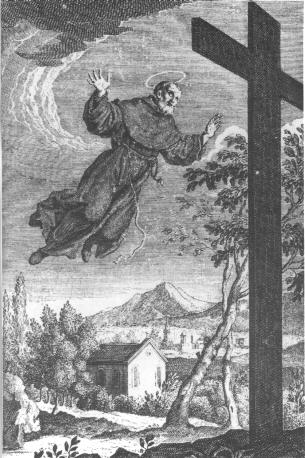
                But then things got really interesting; he began levitating while in ecstasy. While saying Mass or praying he would frequently end up kneeling three or four feet above the ground. On one occasion, while attending Christmas mass, he flew straight to the top of the high alter and knelt there while carols were sung. On another occasion he passed some workers were struggling to raise a thirty-six-foot stone cross into place. So, Giuseppe took the massive cross and simply flew it into place. Yet another story tells of him meeting the Pope (either Urban VIII or Innocent X, no word on which) and bending down to kiss the Holy Father’s feet. At which point both Giuseppe and the astonished Pope began to levitate (I can only imagine what happened next: “sorry, Your Holiness: I do that sometimes”). Sometimes when he and his brethren went out to beg, Giuseppe would suddenly end up in a tree. 

"Weeeeeeee!"
                His levitation was of great interest to everyone else, naturally, but not so much to him. To him, it was just one of those ‘things;’ the point wasn’t that he could fly, the point was that he serve Jesus.
                And flying wasn’t his only superpower either. He could heal people by touching them. He could read minds (his fellow friars would sometimes go up to talk to him, only to find that he knew both what they were about to say and what they weren’t telling him).  He also could talk to the animals (just imagine it!). Once he sent a sparrow to a nearby convent of nuns to “help with their singing.” Later, after one of the sisters shooed it away, he dropped by and was told that the bird hadn’t returned. “Quite right,” he said. “He didn’t come to you to be insulted! But I will try to make amends on your behalf.” Not long after, the bird returned.
                I suppose I should talk a little about miracles here. It may seem far-fetched to us that Giuseppe could fly while contemplating heavenly things. Perhaps, but the question then becomes why? Why is it so hard to believe? True, men do not usually fly, but no one’s claiming that they do; they’re just claiming that this one did, and there seems to be good evidence to support them. He was witnessed to fly at least seventy times during his life, often by large crowds. The stories about him flying didn’t emerge centuries after his death, but during his lifetime. He lived in a sophisticated, well-ordered society, mid-way between the Renaissance and the ‘Enlightenment’
Regarding this last point occasionally invoked explanation that people ‘back then’ were more apt to believe miracles because they knew little or no science, well, that’s bunk. For one thing, ‘people can’t fly’ is not an advanced scientific idea that we have only recently begun to understand; everyone who saw St. Joseph fly was entirely aware that he really shouldn’t have been able to do that. A man is not more apt to believe that someone can fly because he doesn’t know the principles of aerodynamics. If anything, he’s less likely to believe it. People may have been more apt to see the Hand of God in the world while St. Joseph lived, but they were hardly more apt to accept reports of a flying monk during a time when neither man nor anything he made could fly. 
And that’s another thing; we call them ‘Miracles’ because they are things that don’t seem to follow the ordinary laws of nature. Knowing more of those laws doesn’t make miracles more unbelievable. If anything, it makes them more likely (since the more we understand of how nature works, the more apt we are to notice when it doesn’t work the way we expect it to). Faced with reports of St. Joseph’s miracles, we can conclude one of two things; that a large number of both lay and religious people (including the Pope) decided to enter into a conspiracy of lies about this random, rather stupid priest for the sole purpose of putting one over on the believing public, or the man actually did levitate. From what we know, those really are the only two explanations. Saying “it was a long time ago and people were stupid back then” isn’t skepticism: it’s snobbery.
Giuseppe’s levitating caused problems both for him and for the order. People kept flocking to see the flying friar, which rather spoiled the monastic seclusion. Not to mention having one of the congregation (or even the priest) suddenly go into a trance and take off into the sky was a somewhat disruptive event to occur during Mass or prayers. It got to the point where Giuseppe’s brethren responded to the miracles with less “Praise be to God for this sign!” and more “Oh, no; not again!” So, for over thirty years they tried to keep him hidden. They moved him from one convent to another, trying to keep the crowds away (quite apart from the spectacle, he was an excellent confessor who inspired many people to live truly Christian lives). But people kept finding out where he was, somehow, and then they’d have to move him again. Giuseppe was given his own private cell and chapel and had to take his meals alone.
Despite this seclusion, Giuseppe remained irrepressively cheerful all his days. His ecstasies and flights became more frequent as he grew progressively more and more detached from the Earth and developed a Heavenly perspective. He said that all the wars and troubles of the world were nothing but the “play battles of children with pop-guns” (this was right in the midst of the thirty-years war). Finally, at the age of sixty, after a severe period of fever and near-constant ecstasy, Giuseppe died on Sept. 18, 1663. A little over a hundred years later, in 1767, Pope Clement XIII canonized him a Saint. Today, he’s the patron of pilots, air-travelers, astronauts, and the mentally-challenged.
St. Joseph reminds us that God does not necessarily ask for intelligence or even basic competence; He only asks for faith and love. St. Joseph had that faith and love in spades, to the point that he was gifted to see things that the greatest scholars on Earth could never comprehend. He was so unbounded by earthy concerns that he couldn’t even be bothered to obey the laws of gravity. In this way he also shows us that the concerns, trials, and problems that plague as are, really, not worth troubling over. Seen from a Heavenly perspective, they’re nothing more than temporary inconveniences; just like gravity.
St. Joseph of Cupertino, Pray for Us!


P.S. for an only semi-historical, but very entertaining look at St. Joseph’s life, try to track down The Reluctant Saint, starring Maximillian Schell and Ricardo Montalban.

Vive Christus Rex!

Thursday, December 6, 2012

The Real St. Nicholas

St. Nicholas of Myra


Patron of: Children, sailors, the falsely accused.

It’s Advent time! And you know what that means; Christmas is just around the corner! Since we’re going to be hearing a lot about Ol’ St. Nick in the coming weeks (and since today, Dec. 6th, is his feast day), I thought now would be a good time to give you a primer on the real St. Nick. Oh, yes; Santa Claus is real, don’t let anyone tell you differently (as a matter of fact, there are a number of St. Nicks, including one of the greatest Popes of the Middle Ages, but for some reason only one of them got pop-culture status and an academy award for Edmund Gwenn).

Of course, our image of Santa Claus is much different from the real thing. The real St. Nick never went to the North Pole, for instance; he lived in Turkey. As far as we know, he didn’t own a flying sleigh pulled by eight-or-nine reindeer, and ‘Rudolphus’ was the name of his horse (still had a fluorescent red nose though; that part is historical fact).*

*Haven’t been able to find documentation confirming this.

As a matter of fact, the real St. Nick was less like this:

And more like this:
Yes, I’m serious. St. Nicholas was the 4th Century Church’s equivalent of that one uncle who was a Marine before coming home and doing a nickel for assault, but who’s a blast when he comes around for Thanksgiving and always sends you the kind of presents that your parents won’t let you play with until you’re older.

When Nicholas was a boy, growing up in Patara (in modern day Turkey), he was first raised by his rich Christian parents, but then when they died by his uncle and namesake, who was bishop. Young Nicholas was exceptionally religious and devout, so Uncle Nick ordained the young man as a priest.

Once that was done, Nicholas determined to go on pilgrimage to Egypt and the Holy Land, which he duly did (he was the kind of guy who typically got his way when he made up his mind to something). Upon returning from his pilgrimage, Nicholas was installed as Bishop of Myra (another city in Asia Minor). Bad timing, though, since this was during the rise of Diocletian, when Catholics were viewed with suspicion, publically ridiculed, and persecuted for their beliefs.

Mutationis Possumus Credere

Nicholas was comparatively lucky; he only got thrown in prison. Many of his fellow bishops and Christians got executed. Of course, prison meant frequent beatings, torture, and (judging by his later actions) probably his fair-share of fights. Prison life is always rough, and Roman jails were no different. We can assume that, when he wasn’t beating or getting beaten, Nicholas spent his time ‘inside’ evangelizing his fellow prisoners, ministering to fellow Christians, and teaching squealers the price of betrayal.

“Ho ho ho!”
But, of course, Diocletian couldn’t live forever. After his death (and a lot of civil war and intrigue that we can’t get into here), Constantine assumed the throne and declared religious freedom throughout the Empire. Nicholas and his fellow bishops walked free again, though whether any of them went south, built a boat, and started a fishing business with their best friend isn’t recorded. Instead, Nicholas found a bunch of pagan shrines messing up his diocese and inviting a bunch of pesky demons to trouble his people. In response, he went on something of a pious rampage; smashing pagan structures, breaking idols, and driving the presumably-terrified demons out of his city.

So, released from jail and purged of demonic influence, Nicholas resumed his ministry, free at last. But all was not well. An old heresy, given new life by the smarmy, ivory-tower intellectual Bishop Arius of Nicomedia, was seeping through the Church like poison. Arianism, as it was called, denied the Divinity of Christ, instead positing that He was an inferior, intermediary ‘god’ created by God to be a kind of buffer to creation (this was based on the neo-platonic system of belief, which is way too complicated to get into here).

This, as you can imagine, was causing problems; bishops were falling away, and there were ‘Orthodox-vs.-Arian’ riots all throughout the empire. The bishops who remained faithful typically found themselves run out of town by angry mobs, or, alternatively, were stirring up angry mobs to run the Arians out of town.

Constantine, of course, found all this most distressing and tried to settle the matter with a ‘cease and desist’ letter, in which he urged the bishops to stop making such a fuss over matters of no real importance.

That worked about as well as you’d expect.

Having failed spectacularly at his first attempt, the emperor decided to try a different approach. With the help of Pope Sylvester I (of whom there is no recorded instance of his attempting to eat Tweety Bird), the emperor invited all the bishops to meet at Nicea so that they could discuss the matter (Sylvester himself didn’t attend; he had enough work to do in Rome. He did, however, send representatives to ensure a papal presence).

Nicholas, who had spent ten years on the inside for his faith, wasn’t going to stand for some jumped-up little college-boy spreading lies about it; no sir! So he saddled up and, together with bishops from all around the world, made his way to Nicea.

At the council, with Constantine presiding, the bishops heard the different arguments for and against the Divinity of Christ, both from experts and from novices (most notably from a young deacon named Athanasius of Alexandria). 

When Arius got up and made his case, with (presumably) many a sneer and snide remark about the intelligence of his opponents, Nicholas sat quietly and listened for as long as he could, but finally had had enough. He got up and offered his counterargument: a sock to the jaw.
“Consubstantial with the Father, punk!”
For this outburst of righteous anger, Constantine had Nicholas stripped of the symbols of his office: his pallium and personal copy of the Gospels, and threw him in the dungeon to cool off. While he was in there, Nicholas had a vision of Jesus and the Blessed Virgin.

"Why are you here?" Jesus asked.
"Because I love you, my Lord and my God," Nicholas replied.

Then Jesus presented Nicholas with his copy of the Gospels, and Mary re-vested him with his pallium.

Needless to say, when Constantine and the other bishops heard of this, they let Nicholas out of the dungeon and allowed him to rejoin the council.

Whether that well-placed blow and subsequent diving intervention had anything to do with it or not the Council rejected Arianism; affirming that Jesus was “God from God, light from light, true God from true God, begotten not made, consubstantial with the Father;” the same faith that we profess today. 

Final vote?  230 to 2.

Of course, life wasn’t all prison riots and debate-floor brawls; he had his flock to manage. Nicholas may have been a tough-old-spit, but he was a tough-old-spit who loved his people; particularly children. For instance, one famous tale involves a poor father who had three daughters, whom he couldn’t afford dowries for. Nicholas, hearing about this, surreptitiously tossed sacks of gold through the man’s window as each girl came of age, thus saving them from falling into destitution and probably becoming prostitutes.

There’s another story about three soldiers, who were stationed near Myra and came into town on leave. A fight broke out around them, and the three were hauled off to be executed for causing a disturbance. Nicholas arrived to help calm things down (guy knew his way around riots, remember) and witnesses swore to him that the three soldiers were innocent and lamented that if only he had come sooner he could have saved them. Nicholas raced to the jail to find the three men bound and just about to be put to death. As the executioner raised his sword, Nicholas charged in, grabbed it out of the man’s hand and threw it away.

I assume that afterwards he had a stern conversation with the guy on the left about wearing pink skirts.

Another miracle happened during the great famine that occurred at Myra from 311-12; a ship loaded with wheat bound for Constantinople and the Emperor’s table was docked at Myra. Nicholas asked that some of the wheat be given out to help the starving people. The sailors were reluctant, since they’d get in big trouble if they didn’t deliver the correct amount of wheat. Nicholas assured them that they wouldn’t suffer any loss, and so they agreed (again, Nicholas typically got his way). After leaving two-years worth of wheat behind, the sailors moved on to Constantinople, presumably wondering how they let that scary bearded priest talk them into this, and oh, god, they were going to get fired and possibly killed…but upon arrival they found that they had the exact same amount of wheat as they had loaded on.

During that same famine, there’s a story of an evil butcher who decided to save his business by luring three children into his shop, murdering them, and hiding their bodies in vat of pickles to be served later as tenderloins. Nicholas got word of it, uncovered the bodies, and miraculously brought the three boys back to life (no word on what he did to the butcher; it probably wasn’t pretty).

St. Nicholas: if you hurt children he will beat you to death and then raise you from the dead to do it again.

So you’d better watch out. You’d better not lie. You’d better not blaspheme, or he’ll make you cry…
He died on the 6th of December, in either 345 or 352 (we’re a little hazy on how or where exactly), and was buried on the island of Gemile. Most of his relics, however, were removed in the 11th century in the wake of the invading Turks and today reside in Venice.

Devotion to St. Nicholas includes the practice of giving gifts to children on his feast day. Traditionally, children would leave their shoes outside their doors at night, which their parents would fill with goodies to be discovered when they awoke. Over the years, and thanks to a large commercialization effort, this has morphed into the image of Santa Claus that so dominates the Advent season (though I’m still not clear why we have a fat, jolly-old reindeer-farmer/toy-maker instead of a badass ex-con heresy-and-crime fighter/demon slayer)

As a side note, while I’m not necessarily against Santa Claus, I can’t help thinking that St. Nicholas would have been a bit miffed to discover that a cuddly hallmark version of himself has largely usurped the celebration of Christmas from Jesus. I imagine he would have words for the people and organizations responsible. And by ‘words’ I mean ‘savage beatings.’

Be afraid, Coca-Cola; be very afraid.
St. Nicholas, pray for us that the True Meaning of Christmas may shine through.

Sources:

Vive Christus Rex!

Tuesday, November 20, 2012

Our Patron and Our Aim

                  There was a young man living in France in the latter half of the sixteenth century named Francis. His father was a rich lawyer and, naturally, expected his eldest son to become one as well, so he sent Francis off to the current equivalent of Harvard law-school. Francis, however, had a Dead Poets Society style experience and decided that he’d much rather become a priest. So he quit his job as a lawyer, rejected the stuffy society chick his dad had picked out for him, and entered the seminary. His father tried to intervene, but fortunately Francis had the very cool (and presumably Robin-Williams-esque) Bishop of Geneva on his side, who managed to convince Francis Sr. to give in.
                  Not content with his cushy office in the Diocese of Geneva, Francis decided to go off and evangelize the region of Le Chablais AKA Huguenot central. Ever see the movie The Warriors? It’s basically like that, except there was only Francis and his cousin, they were unarmed, and they went there on purpose to evangelize (also, the villain here was Calvin, not Luther). 
"Catholics! Come out and plaaaaayyy!"
                  After camping out in the winter, hiding from wolves, and a couple of assassination attempts, Francis’s cousin said “screw this!” and left. Francis himself, meanwhile, was having trouble getting his message across since people kept slamming their doors in his face:
                  “I’d like to talk to you about the Eucharist-” *SLAM*
                  “Historically speaking, the Papacy-“ *SLAM*
                  “Wolves tasted my blood and I think they want more-“ *SLAM*
                  So, unwilling to give up, Francis took to writing out his sermons, copying them by hand, and slipping them under people’s doors. In this way, he slowly evangelized the entire region and, eventually, brought a large chunk of the population (read: a couple thousand) back into the Catholic Church, all while pioneering the first crude form of blogging. That is why today Saint Francis de Sales is the patron saint of writers, journalists, and (presumably) bloggers.
                  He’s also our patron saint here at the Catholic Nerd. See, Francis was famous for more than just an insane determination to evangelize; he also championed the uniqueness of each individual. After his adventures in Huguenot-and-wolf land, he came back and succeeded sixteenth-century Robin Williams as Bishop of Geneva, in which capacity he set about writing books on how anyone from any walk of life could become a saint. He wrote about how you can still have fun and be yourself while serving God. “Be who you are,” he said. “And be that well.”
                  Here at the Catholic Nerd, we seek to become the best possible versions of ourselves. We intend to integrate our particular interests, talents, and experiences into the life of Christ. We constantly seek improvement in our personal, spiritual, and professional lives. We eagerly proclaim the Gospel of Jesus Christ, as handed on through the Apostles and their successors, the Bishops. And we seek to baptize the culture around us by our words, works, and examples.
                  St. Francis de Sales, pray for us.
                  Vive Christus Rex!